
Malaria Control in Kanyashande Village.
Over the next few weeks we would like to share with you a series of stories from the Community Team at BCH about their most recent successes and challenges within the rural villages in the catchment area of Bwindi Community hospital.
First we go to Kanyashande Village to hear about their interventions to reduce Malaria.
World Health Organization (WHO) ranks Uganda as one of the countries in the world with the highest malaria incidence rate of 478 cases per 1000 population per year. WHO goes ahead to report that malaria accounts for up to 40% of outpatient visits in Uganda.
At Bwindi Community Hospital (BCH) malaria accounted for 0.5% Out Patient Department (OPD) visits between January to September 2024 where on 69 cases were registered at OPD with in this period. Most of these cases came from Mukono (16%), Kyumbugushu (10%), Mukongoro (9%) and Kanyashande (7%) villages. Before our targeted interventions in Kanyashande Village, it has been the leading village with the highest number of malaria cases attending at BCH OPD.
Kanyashade village is found in Northern ward Buhoma Town Council in Kinkiizi, West Health Sub Districts in Kanungu district. The Community Health and Batwa (CH&B) staff at BCH conducted a survey in the village in March 2024. The following were found to be the enabling factors for malaria incidence in the village:-
- The village is bordering with river Munyaga and during rainy season it is full and a lot of water logs (in Swamps) in the village which favors mosquito breeding.
- Most household did not have mesh in their ventilators to prevent mosquitoes entering in.
- Most households did not have enough insecticide mosquito nets (ITNs) and some were old to give the protection to household members.
- It was reported that mosquito nets had taken long time without being sprayed with mosquito repellants.
- Most households are located within banana plantations and during planting seasons they do intercropping which creates bushes for mosquito breeding and hiding.
- During the survey, it was observed that most people in the village they do brick making and after they do not fill the holes and during rainy season they are full of water hence creating spaces for mosquito breeding.
- Participants in the survey reported that they do not usually close doors and windows early in evening which allows mosquitoes to enter in the house and bite residents at night.
- Most households are near each other which makes the transmission very easily because an infected mosquito can move from one house hold to another easily.
- Most people are poor they cannot buy the mosquito nets, they wait the government to give them free mosquito nets which is done every after 5 years.
- Most households are not painted with bright colored paint and mosquitoes easily hide themselves in the dark comers of the houses.
- Poor waste disposal especially empty tins, broke utensils, polyene bags, empty plastic bottles which harbor mosquitoes and facilitate their breeding.
After identifying these factors through the survey the following interventions were put in place:-
- All the households identified with malaria cases were visited and sensitized about Malaria.
- During World Malaria Day cerebrations, we decided to hold the celebrations in Kanyashade Village and we distributed 200 ITNs to the households as stipulated in intervention “1” above.
- We also did sensitization through a local church and ‘Bataka’ gathering about measures to prevent malaria.
- Village Health Team (VHT) members in the village were encouraged to move from house to house doing sensitization about malaria prevention.
- Members also were encouraged to clear the bushes around the house and has proper disposal of waste especially broken empty tins, polythene bags, etc.
- Giving an ITN to every confirmed case of malaria identified at BCH OPD.
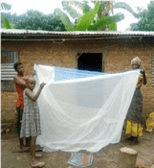
Above: Community members receiving mosquito nets on world malaria day
Below: CH&B staff Carrying out a malaria sensitization in Kanyashande village on World Malaria Day (25th April 2024)
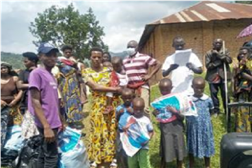
After the above interventions in Kanyanshande, the village is no longer taking up the 1st position of having the highest number of malaria cases but was the 4th after Mukono, Kyumbugushu and Mukongoro. Its percentage OPD attendance at BCH of malaria cases has decreased from 36% between January to September 2023 to 7% in the same period in 2024. Malaria-prevention strategies are effective if they are implemented well by all stakeholders as we have seen in the case of Kanyashande Village. The use of ITNs by community members appears to be playing a vital role in the controlling malaria spread in communities; since it was one of the major interventions in Kanyashande village. We hope to continue implementing all the above interventions in Kayanshande village and other villages to bring down the percentage of malaria cases from each of the villages to less than 5 %.
If you would like to support the Community Team, taking health care to some of the most remote and difficult to access villages surrounding Bwindi community hospital, why not become ‘twinned’ with a village! Have a look at our Twinning page for more information.
 reachbwindi.com